Nobel Peace Laureates share
lessons for today's troubled world
Liz Bernstein,
Nairboi, Kenya, Thursday 02 December 2004
Nobel Laureates gathered in Nairobi to share lessons of
different tools used to advance human rights, promote sustainable development
and strengthen human security in the face of violent conflict in the 21st
century.
The event, a panel discussion hosted by the International
Campaign to Ban Landmines (ICBL) took place during the historic Nairobi Summit
on a Mine-Free World. The discussion focused on the theme "Linking
Humanitarian, Development, and Disarmament Responses to War". The
panel included five individuals and organisations recognized by the Nobel
Committee for their extraordinary contributions to a better world.
The President of the International Committee of the Red
Cross (ICRC), Dr. Jakob Kellenberger, initiated the discussion. The ICRC, whose
founder was awarded the first Nobel Peace Prize in 1901, subsequently received
the prize three times (1917, 1944 and 1963). Dr. Kellenberger, who just
returned from a week trip to Sudan, including Darfur, noted the first response
of the ICRC in disseminating international humanitarian law, monitoring its
implementation and its respect is securing access. He drew lessons from his
recent experience in Darfur on access issues as well as confronting serious
violations of international humanitarian law. He noted that regular armed
forces or armed irregular groups may show disregard for the body of
international law, question its force or adequacy, such as in the war on
terror, but urged participants to remember the human dignity of each human
being. “The respect of human dignity in all circumstances may be the best
investment in long term human security.”
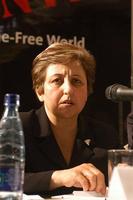
Shirin Ebadi from Iran. Photo: Brian Liu/Toolbox Design
Shirin Ebadi, advocate for democracy and human
rights from Iran and last year's winner, first addressed the issue of the
rights of women. She noted that while the manner of discrimination may vary in
different parts of the world, discrimination against women exists all over the
world and we must defend the rights of women in all cultures. She also noted
that fundamental human rights and justice are “the two pillars of peace.” She
highlighted inequality in the world today, where in many countries more than
80% of the population earns less than one dollar a day, while in other
countries in the US and Europe, people spend more than $2 billion a year on pet
food. “We must learn to live together and allow all of us to enjoy the
fruits of the planet.”
Martin Barber spoke on behalf of the United
Nations, whose agencies have been awarded the prize several times and most
recently in 2001, when the UN and Secretary-General Kofi Annan received the
award jointly. Barber cited a recent article in The Economist magazine which
claimed that the role of international law is in crisis and the relevance of
the UN is challenged as never before, questioning the fate of the organization.
He then responded by elaborating ways the UN has tried to respond to the
challenges facing countries emerging from conflict more effectively. He
highlighted efforts to coordinate responses of the UN system as well as
engaging in realistic demobilization, disarmament and rehabilitation projects.
In closing, Barber noted “the UN is not dead yet ? it embodies a great ideal
and we will be with you for some time to come.”

Nobel Peace prize laureate Wangari Maathai. Photo: Brian Liu/Toolbox Design
Wangari Maathai, the most recent laureate, who will
receive her award in Oslo on 10 December, began by highlighting common threads.
“Justice, consciousness, development, security, community, threat, democracy ?
all can be used in describing our concern for the environment.” Maathai noted
that in her Greenbelt Movement they first began working with women who didn’t
have food, water, firewood, and then came to realize that they needed to
address the causes - lacking basic needs due to environmental degradation.
There was less and less land for cultivation, grazing animals, gathering
firewood, collecting water. “We realized that in all likelihood they would
fight over these scarce resources. It is important to manage resources
sustainably so there is enough for all of us or people will start fighting over
them.”
She recounted how they then began to organize the women,
to mobilize them to work together, plant trees, and reclaim resources. “We were
told we could not meet, if we were more than 9 people we needed a license to
gather. Eventually we came to understand that the law was put in place to
control people because when people come together they organize, and when they
organize they empower themselves, and when they empower themselves they say no
to power.”
Maathai related how in saying no, in reclaiming space
that was disappearing due to desertification and privatization, they also
needed to reclaim democratic space. “In trying to see how we could reclaim
those natural resources and bring about results quickly, so we didn’t lose hope
but could see fruits of our labor, we planted trees, which also provided the
women with food, firewood, shelter, and if properly protected, forests and
water. We could use trees to reclaim our land and our spirits. We would
plant trees of peace? planting seeds for peace, democracy and respect for human
rights.”
Jody Williams speaks at the panel. Photo: Brian Liu/Toolbox Design
Jody Williams, who won the prize together with
the International Campaign to Ban Landmines in 1997, was the final panelist.
She began by noting that she also had been making lists of themes of things
that ran through the evening’s conversation and all were elements of human
security. She noted that one of the interesting things to emerge from the
landmine movement was the attempt by some governments to create a network to
deal with human security ? the Human Security Network ? and it needs the
support of civil society. “If we are going to address the needs of all of us
on the planet we must define security not in terms of military weapons but in
terms of basic human rights ?enhanced human security provides for global
security.” Williams then addressed how real peace means a reallocation of
resources, and that people must begin to realize “to shop is not a basic human
right. People in the North and West must realize when we consume 50 times the
resources we are robbing the South and their hope for a better future. There is
something wrong with the planet when almost $1 trillion is spent on weapons and
war and $10 billion on education. There is something wrong when 3 billionaires
have more resources than the poorest 48 countries combined. There is something
wrong with the global system that permits and accepts and glorifies this.”
“Those of us in the landmine movement have seen the power
of real change, when we work together, with bold leadership of governments,
stepping outside of the bureaucracy. It takes courage and leadership for
each and every one of us, including governments, who must decide to look at the
world differently.” Williams closed by applauding the Nobel Committee for
expanding what it means to defend peace “the committee got it ? they recognize
that we must defend our environment or we’ll have no planet left” and
remembering sister laureate Aung San Suu Kyi, still imprisoned in Burma. “We
need to do more to support her.”
About 400 government and non-governmental delegates to
the Summit as well as members of the Nairobi diplomatic community participated.
David Atwood, of the Quaker United Nations Office, another Nobel laureate,
moderated the panel on behalf of the ICBL.
Former president of the ICRC and current president of the Geneva
International Centre for Humanitarian Deming, GICHD, Cornelio Sommaruga asking a
question to the Nobel Peace Prize laureates. Photo: Brian Liu/Toolbox Design