November 2005
Oscar Ugarteche
Institute of Economic Research
National University of Mexico, UNAM
THE RISE AND FALL OF THE IMF
The issue is whether International Financial Institutions can be
reformed or not. This paper will review the considerations in the creation
of the IMF and the riole played by the US a the time, the manner in which
the IMF has operated, the results to date and then briefly will look at
the World Bank. It begins by reviewing the debt crisis and what led up
to it in the 1970’s. There are many arguments on the roots and this paper
takes a position on a monetarist argument. Then it reviews the process
of debt rescheduling as the role of the Fund then with the adverse consequences
on the economy of Latin American countries. Then it proceeds to look at
the results of structural reforms to conclude that the institutions do
not seem to work to their own ends. It makes a review of the IMF role
in the Asian and Argentina crisis and passes review on the external debt
renegotiation mechanism and proposes in the concluding remarks another
international financial architecture without the existing IMF and with
a much reduced WB dedicated to data gathering. The paper seconds Bello’s
idea of a regional monetary fund, proposes an international board of arbitration
for sovereign debt and downplays the role of the World bank, taking from
Broad’s idea.
 The creation of
the IMF in 1944 resulted directly from the instability of the world economy
during the 1930’s as a consequence of deflation that derived from the
gold standard and depression that came from the application of the beggar
thy neighbour policies plus a crisis of overproduction. The end of the
gold standard in 1933 paved the way for a new international reserve standard,
grounded on gold. This was to become the gold/dollar standard established
in 1944 at a fixed rate of US$35.70 per ounce of gold, the price at which
gold had been in the markets since the 1930’s. The reason for having the
US dollar convertible to gold was because the United States had the strongest
economy, was the world’s creditor, had the largest amount of international
reserves and the US dollar effectively served as the world monetary reserve
asset. The United Kingdom, previously a major international reserve economy,
was no longer in a position to serve that function. It had turned into
a debtor country during World War I and not withstanding that the United
States waived those debts, it again became an important international
debtor during World War II. The creation of
the IMF in 1944 resulted directly from the instability of the world economy
during the 1930’s as a consequence of deflation that derived from the
gold standard and depression that came from the application of the beggar
thy neighbour policies plus a crisis of overproduction. The end of the
gold standard in 1933 paved the way for a new international reserve standard,
grounded on gold. This was to become the gold/dollar standard established
in 1944 at a fixed rate of US$35.70 per ounce of gold, the price at which
gold had been in the markets since the 1930’s. The reason for having the
US dollar convertible to gold was because the United States had the strongest
economy, was the world’s creditor, had the largest amount of international
reserves and the US dollar effectively served as the world monetary reserve
asset. The United Kingdom, previously a major international reserve economy,
was no longer in a position to serve that function. It had turned into
a debtor country during World War I and not withstanding that the United
States waived those debts, it again became an important international
debtor during World War II.
The concept of
a currency stabilization board started developing since the 1930’s with
various currency stabilization plans being designed between 1931 and 1935.
(Eichengreen, 1989) Only when the US Treasury decided to put its pressure
to obtain it, did it work. It was when Cordell Hull at the State Department
decided that multilateralism was essential for the future of humanity
and for the stability of world peace that the concept was more properly
developed under the guidance of Harry White, pupil of Jacob Viner (1943).
The establishment of the IMF in Washington DC in 1946 was to mark not
only the importance of the institution for American foreign policy but
its influence over it. With the definite disappearance of the concept
of a board of international debt launched at the League of Nations during
the 1930’s, the issue of US Confederate State unpaid debts of the 1840’s
(CFB, 1955) disappeared from the international agenda and the new institution
was able to operate fresh on the basis of US law. It was the law of the
major creditor and major reserve holder in the world then, and is the
law for most international financial transactions after World War II.
The debt problem: a monetarist view
Most analysts place
the roots for the debt problems in major irresponsible borrowings, a large
State sector, market distortions, corruption and public sector and balance
of payments deficits. These analysts usually add to this the petrodollar
crises which raised external deficit leading to what became known as the
“debt crisis”. There are exceptions to this view such as Edwards and Larrain
(1989), Griffiths Jones (1988) and more recently Hammes and Wills (2003).
We wish to return to the U.S. interest rate analysis and the external
shock element of the crisis, in order to follow the role of the IMF in
it. James (1996: 355)) suggests that the IMF was worried in 1982 about
the impact of US interest rates and that the impact of interest rate shocks
went beyond immediate service costs
The 1970’s started
with the delinking of the US dollar from gold at a fixed rate and the
opening of the international gold and currency markets, on August 15,
1971 with the Smithsonian Agreement. It was done without consulting the
IMF and marked the end of fixed exchange rates, the scheme designed to
keep a stable world after WWII that gave the IMF its sense of mission.
The managing Director of the IMF, Schweitzer, was invited, with one
hour’s notice, to attend a meeting in the U.S. Treasury with ? Fed President?
Paul Volcker (Secretary?of the Treasury?Connolly was in the White House)
who told him about the major elements in the Nixon Program…Then Schweitzer
was able to see Nixon’s speech on television (James, 220)
The disregard for
the institution meant to keep stability in the world economy is interesting
because it introduces the position of the US Government towards the IMF.
It has been used as a tool of US foreign policy but not kept in regard
for purposes of international financial stability. The 1970’s was a time
of cheap money and loan pushing as a result of the deregulation of the
currency and gold markets. With the end of fixed parity and the dollar/gold
standard, raw materials prices soared in US$ prices as exporters sought
to put some order into those markets upset by the major changes after
the Smithsonian Agreement of August 1971. The dollar price of gold went
from 35 dollars an ounce to 455 dollars an ounce by 1980 and commodity
prices tended to follow a gold reference which increased substantially
reflecting the devaluation of the US dollar. According to Hammes and Wills,
commodity prices in gold remained stable during the 1970’s.
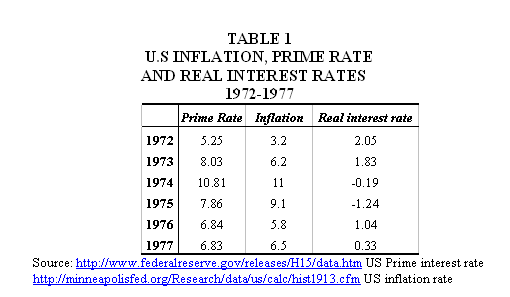
The effective real
interest rate of US dollars plummeted with the prime rate reaching an
average of ?0..75% between 1974 and 1975 while inflation reached an average
of 10% per annum. This opened the way to much irresponsible borrowing
and lending . The credit cycle entered its boom period at the time, to
put it in Marichal’s terms.(1989) Actually the credit cycle started in
the 1960’s and accelerated as the supply of credit curve became steeper
with more dollar liquidity entering the international banking circuits
after 1971..(Ugarteche, 1986) Inflation soared in the United States from
3.2% in 1972 to 11% in 1974.(table 1) The effects of the oil price increase
in December 1973 was to be seen starting from mid 1974 and more clearly
in 1975. US inflation in 1973 and 1974 resulted from excess dollar liquidity
rather than from oil price shocks. Those came later and were added to
the first.
 |
At the time developing
nations borrowed because either: 1) they had oil and could afford it,
especially at negative or very low rates, 2) because they did not have
oil and had to cover massive deficit and could afford it at those rates.
Lenders, public and private, overexposed themselves, while debtor nations
held uncontrolled budget and balance of payments deficits around the world.
The exchange rate fluctuations of the dollar and the search for a more
stable exchange rate mechanisms on the side of the French, led to what
is known as the Rambouillet agreement. The meeting took place at the French
town on November, 15, 1975 and both sides reached and agreement as to
the need to have an orderly exchange rate mechanism without fixed parity.
There was the mistaken perception that U.S. dollar financial flows would
be cheap and permanent as the average interest rate between 1973 and 1977
was practically nil. At this time, after many discussion as where to go
with the IMF, some changes where introduced particularly referring to
Article IV. The IMF would be kept out of the daily follow-up of exchange
rates made by France and The United States. (James, 1989,: 269)
In lieu of a system of rules, the new article IV set about a new philosophy
of management of the international economy. Section 1 referred to the
obligation of members of the Fund “to assure orderly exchange arrangements
and to promote a stable system of exchange rates” (that is not “a system
of stable exchange rates”) Section 4, indefinitely postponed (at least
as long as the United States was opposed) the readoption of par values.
“The Fund may determine, by an eighty five percent majority of the total
voting power, that international economic conditions permit the introduction
of a widespread system of exchange arrangements based on stable but
adjustable par values”…In practice it seemed unlikely that a new stable
system would be put in place soon. (James, 272)
The conditions
after the Rambouillet meeting weakened the Fund to the point that economic
policy summits between leading nations replaced previous discussion at
the IMF. The G4, then G5 and later G7 countries made up a small “Library
Group” (James, 266) that held its own discussions that allowed them to
coordinate their economic policy. Giscard d’Estaing described it as “a
private, informal meeting of those who really matter in the world”, (James,
267) whilst the other lesser developed economies held their discussions
at the IMF and followed its prescriptions to a greater or lesser degree.
In the mid 1970’s
some debtor nations started entering payments problems, such as Zaire,
Jamaica, Egypt and Peru so in 1976 a new role was quickly found: that
of “policeman for the banks” and advisor to debtor countries for debt
negotiations. Exceptionally in 1976, President Ford obliged the British
Labour Government to swallow a two year IMF standby with all its conditions
in 1976.(James, 281) The Extended Fund Facility was introduced at the
Fund in 1975 with increased conditionality than the one relating to one
year standby loans. Then executive director stated that lending without
conditionality made no sense. This became the rule for longer period adjustments.
G7 creditors gathered at the Club of Paris do not consider renegotiating
a debt without the Fund’s approval. It was a policeman with a big stick
It must be pointed out that both the G7 and the Club of Paris are informal
associations of leading rich country interests..
In the late 1970’s
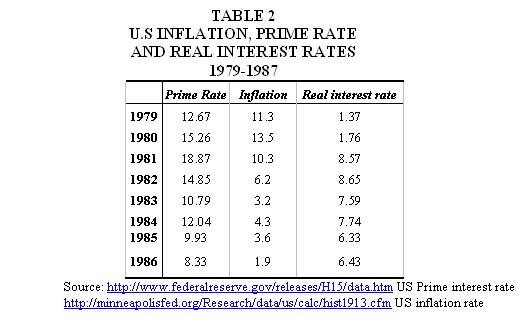
however real interests rate started to increase as stagflation began to
be felt and Volcker applied a restrictive monetary policy from 1979 onwards.
Eventually, in 1981, Reaganomics was introduced to reactivate the US economy,
injecting a massive budget deficit while keeping the brakes on monetary
supply. The consequence was a leap in real interest rates from 1.76% to
8.57% between 1980 and 1981 with the inverse effect on commodity prices.
As inflation was put under control, U.S. domestic interest rates starting
to go down and real rates were reduced. It took until 1992 to return to
more or less normal average rates from before the crisis although they
never returned to pre 1972 real rates.
US monetary policy and the debt problem
The pattern of real
interest rates over fifty years b has four well defined periods:
1. from 1956 to 1972 real interest rates had an
average of 2.67%.
2. From 1973 to 1978 it dropped to 0.53% with a period of negative
rates at the bottom between 1974 and 1975 of ?0.75%.
3. From 1979 to 1986 it leaped to 6.05%
4. From 1987 to 2005 it reduced to 4.46% |
All debtor nations
with a primary exports base, entered defaults from 1982 onwards almost
simultaneously when together with the rise in interest rates, commodities
prices collapsed, and net resource transfers became sharply negative.
From then on, in a continuous motion, debtors refinanced unpaid capital
and interest due of the past year making them repayable in the following
eight years. This increased the debt service ratio in a ladder effect
for the next nine years. The IMF seemed to worried about the stability
of the United States banking system more than about the stability of developing
economies and acted accordingly. It served for all practical purposes
as a foreign policy instrument of the US Treasury more than as a stabilizer
of the world economy. Says Boughton (21), “Major parts of the world, however,
suffered some of the most severe economic stresses of the century”. How
did this come about?
GRAPH 1
 |
The ladder
effect
The ladder effect refers to the escalating weight of refinancing on Government
revenues if capital is rescheduled every year and interest remain paid,
given revenue restrictions. The existing bank refinancing mechanism of
the 1980’s led to the following effect: The first year of default, the
quota of unpaid capital would be restructured into a ten year loan. For
example, in a 10 million dollars, ten year loan, one million be the yearly
amortization quota. This amount would be restructured into a another ten
year loan. If revenues fell during the entire decade, using this mechanism,
the debt increased as follows. In the fourth round of refinancing, the
debtor would be induced into a total default because it reaches the breakeven
point between paying the entire original debt or rescheduling yearly payments,
considering interest was kept up to date. This rescheduling mechanism
sent the countries into default rather than help them recover payback
capacity. The procedure of refinancing the unpaid capital year by year
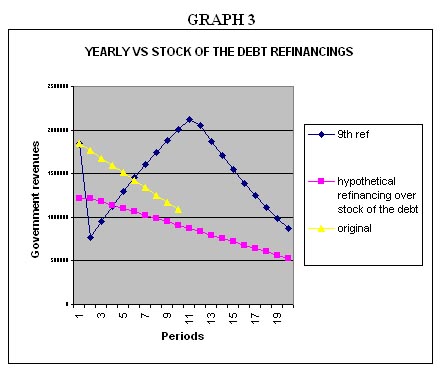
was what in the end made the debt unmanageable. Had the entire stock of
the debt been reprogrammed in the first place over a longer payback period,
this escalating weight would not have occurred.(see graph 2)
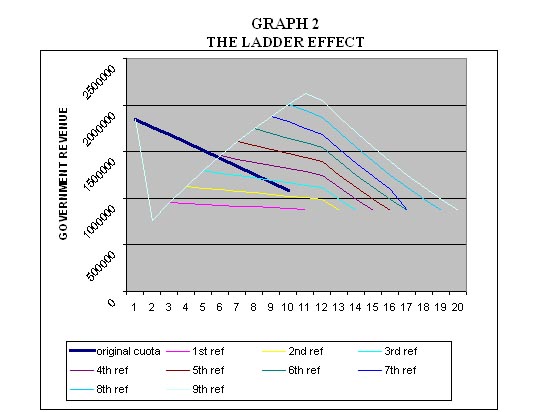 |
The thick line is the original payback schedule and the thinner lines
are the increasing steps in terms use of Government revenues starting
from rescheduling 1 through 9, where the first three refinancing reduced
the amount of the quotas, but starting from the fourth, it is above the
original payback schedule. There were nine rounds of refinancing during
the 1980’s. At then end the stock was still due, but the amount really
paid was almost twice what it would have been if payments had been made
on time in the first place, had there been revenue to do so.
The
schedules after nine rounds of refinancing extend over a 20 year period
overall, as each round has the same ten year payback period as the original
loan. The same exercise with total debt rescheduling over twenty years
produces a vastly different scenario.
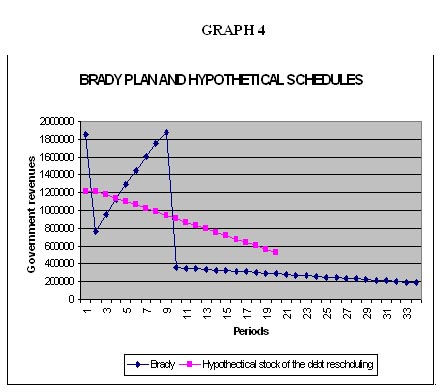
The
Brady Plan solution in fact reduced the stock of the debt by half after
debt service had more than covered the stock of the debt under the guise
of increased overall interest payment in each round. The 10 year ten million
dollar loan ends up being paid back over thirty four years and costing
20 million dollars. Over the initial 10 year period, with nine rounds
of refinancing, this 10 m dollars loan cost 13 millions and the stock
of the debt remains intact at 9 million dollars. If Brady had not come
with a plan to reduce the stock of the debt to market values, which reduced
them by around 55% and reduced interest rates to 4%, the debt would not
have been manageable. (see graph 4)
 |
The
really existing rescheduling mechanism was set in place with IMF assistance
and coercion, with no appearance of the institution to side with the debtor
in the externally generated problem. If the object of the IMF was to maintain
international stability, the result is mixed, while it did prevent a possible
US banking crisis, on the other hand it launched Latin America and Africa
into a depression metaphorically referred to as “the lost decade” and
the ensuing policies have not been able to recover what was lost in incomes
and production after 25 years. The cost of the debt during the 1980’s
was more than what was borrowed and then the stock remained the same at
the end of the decade as a result of this ladder effect. Between 1982
and 1989 rescheduling were done yearly while flows remained negative and
both export revenues and tax incomes dropped sharply in Africa and Latin
America as commodity prices fell and economic activity was depressed.
 |
The
role of the Fund during this period seems more related to the US Treasury
and U.S banking stability while they made sure there was a negative net
flow of capital in developing economies in order to maintain world stability.
They were more worried about adjustment policies and how to face the high
costs of the debt rather than doing something about the real origins of
the international monetary strains. Stiglitz refers to the Latin American
experience with the IMF as correct, as having done the right thing, however
the debt management experience was not only unfair, but unreasonable.
IMF policies did not tackle the problems of high international interest
rates and falling commodity prices but instead centered on the State as
an inefficient assigner of resources, following the new classical synthesis.
Inflation, on the other hand, did not go down during the 1980’s, but inversely
went up and this led many Governments to shy away from Fund prescriptions
because their effects where not positive and they became politically difficult
to swallow. Some Governments applied heterodox policies trying to get
inflation under control but in all three cases it proved positive in the
very short run but useless in the medium term as they all landed in hyperinflation:
these are Brazil, Argentina and Peru between 1985 and 1989. As the IMF
macroeconomic model became improved and the international interest rates
went down slowly, the external sector became more manageable. Nevertheless
the consequence of the compression of consumption and savings was negative
for both the economics and the politics of the region during the period.
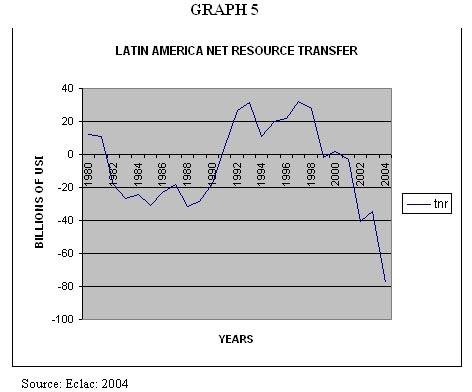
What followed in terms of recovery of flows of capital, seems to have
been related to privatization and opening up of the financial sector,
mainly. It did not last more than six years and with international imbalances
adverse to developing economies, after 1998 the flows for Latin America,
at least, turned negative again. Over the last twenty five years, there
have been six years of positive flows according tom ECLA. The region loses
capital permanently. Included in graph 5 are long term financial flows:
direct investment and long term loans.
 |
The Brady Plan
Some
discussions were held within Latin America in order to face what was a
very serious economic problem that led to dire political consequences
in the region. The IMF kept to the side of these. The discussion on the
use of bonds in order to have a long run, one time reprogramming, was
made in Latin America by Ugarteche (1984) Luis Carlos Bresser of Brasil
in 1987 (1995), but also was a major part of the discussion held amongst
Latin American academics as to how to come out of an entangled system
that was depressing the region. In every major debtor country someone
was speaking of bond conversions using the XIXth century history of debt
crises solutions. In the US, Prof. Kenen from Princeton brought the point
up in the early 1980’s. There was a consensus in Latin America by the
time the Baker plan was designed in 1985, that only a long payback period
with a return to the original amount owed in 1981 would make the debt
payable. It was clear that the debt incurred between 1982 and 1985 was
not voluntary for any of the parties, neither creditors nor debtors. That
is why the Baker Plan failed in 1985. This led to the consensus amongst
debtors that very long term bonds were the only reasonable answer. The
Brady Plan in 1989, has elements of the Bresser Plan proposed in 1987.
Debt reductions under the Brady Plan however were nowhere near to the
debt increase caused during the decade by continuous refinancing and the
unusually high US$ interest rates.(see graph 3) The IMF, and Witteveen
at the time Ezxecutive Director, were more concerned with “correct” economic
policies, than with the external elements that had induced an economic
crisis of major dimensions to dozens of countries.(James, 322) Conditionality
was then the name of the game and the sole object of the Fund was that
countries follow their prescriptions in order to restore a sound economy.
The only one that was not induced in this direction, and the IMF has no
power to make it do so, is the United States.
Boughton
suggests that the changes required from the Fund were met at the various
breaking points between the 1970’s and 1980’s:
The Bretton Woods system of fixed but adjustable exchange rates came
under strain and collapsed, and a more flexible system was negotiated.
Because the new system imposed few constraints on national economic
policies, the Fund was drawn into a more active “surveillance” role
in overseeing its implementation. Moreover, as the landscape of the
world economy became more precarious, the Fund was drawn into a more
active lending role that required a deeper and more sustained involvement
in the formulation of macroeconomic policies in countries facing economic
crises. During the 11 years covered in this work, 1979 through 1989,
a confluence of upheavals propelled the 01institution into a more central
and pervasive role than ever before. (Boughton, 2001: 1-2)
Throughout
the 1980’s Governments were pressed by the IMF and the Club of Paris,
to pay up and follow their policies leading to high, and very high inflation
? after the adjustment programmes were introduced and tightened? which
over time generated adjustment and refinancing fatigue. Incomes fell,
growth fell, wages fell, consumption as a result also fell, political
instability grew, income distribution worsened. Only then inflation was
controlled and exports grew.
At
the same time the Soviet block collapsed and its member countries opened
to western trade, China grew into a major trading partner for most of
the west and the role of the State was reduced as market orientated policies
were put in place in every country either voluntarily or through adjustment
policies. IMF adjustments agreed upon at the Institute of International
Economics conference of 1982 were applied throughout the developing world
as debt problems surged as a result of the above mentioned interest rate
explosion. The uniformisation of policies allowed for what is now called
“globalization” and fostered the new trading blocks, including those frustrated
like the FTAA. It accelerated intra Asian trade and later in 1992 the
formation of the European Union with its 25 member country projection.
Africa was left for humanitarian aid and Latin America lost relevance
all together. Mercosur was formed in 1994 between Brazil, Argentina, Uruguay
and Paraguay and the Andean Community underwent a refurbishing from Andean
Pact to Andean Community of nations as a sign that it had modernized and
left the role of the State aside. N o doubt the IMF was a weapon of the
G7 but more so of the US Treasury in the fight towards globalization understood
as open markets for goods and services, particularly as the Soviet Union
collapsed.
The philosophical and economic barriers between North and South and
between East and West remained in place at the end of the 1980s, but
the means for destroying them were nearer and more evident than ever
before in history. This “silent revolution,” as Michel Camdessus named
it in a more specific context, brought an unprecedented importance to
the IMF as every region in the world struggled to keep its footing in
an increasingly dynamic and global economy….To a great extent, the silent
revolution of the 1980s resulted from a shift in economic philosophy
toward a new classical synthesis in which government has an indirect
role in, but not a direct responsibility for, ensuring national economic
prosperity; in which private economic activity is promoted through good
governance and the development of physical and social infrastructure.
(Boughton: 3)
The
IMF was at the time the guarantor of these “sound” economic policies and
any doubt as to this matter were eliminated by the Club of Paris who would
not sit down with the debtor nations unless the IMF had done its work.
Boughton, IMF historian, admits the Fund is a political organization and
that it played its role at the time. It must also be understood that the
universalisation of the new classical synthesis had a political interest,
over and above, its intellectual importance. Debtor governments had to
comply to conditionality based on the new classical synthesis in order
to return to the next round of debt negotiations at the Club of Paris
and the London Club, for example. Primary budget surplus became as much
a rule as trade liberalization, privatization and elimination of subsidies
and market distortions. That this was a prescription for some countries
and that in that measure it gave facilities to other stronger countries
is not mentioned by Boughton. That the flying geese concept of Asia as
having first started with import substitution, then advanced to substituting
complex imported products, then advanced to simple export substitution
and later ended in complex goods export substitution was ignored. Ministry
of Finance officials spent many years during the decade negotiating with
the IMF, the Club of Paris, the London Club and readjusting IMF projections,
in order to jump the hurdle of not being in arrears and only to start
the same exercise as soon as the previous cycle was completed. IN the
end, import substitution policies were eliminated, with no later stages
developed, and whatever the result, that was the optimal outcome of the
model. Evidently, the result of IMF/WB conditionality in terms of economic
growth is not very flattering, as can be seen below for Latin America
as a whole. It appears that the economy grew until 1980 and then it has
followed a seesaw pattern approximating 0 per capita growth average for
the 1990’s. While this happened, European country deficits were increasing
as were US deficits in the pursuit of contra cyclical policies. The major
surplus country was China followed by Japan. The leading deficit country
is and has been the United States.
 |
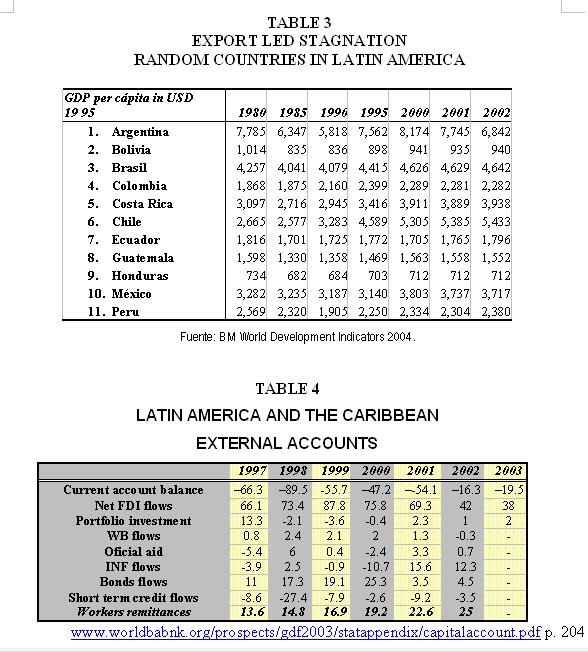
If
we take income per head of 1980 as the base year, before the so called
debt crisis erupted, and see the point at 2002, last data provided by
the World Bank in 1995 dollars, it is evident that out of eleven countries,
Chile stands out as having doubled its per capita income.(see table 3)
The rest are more or less in the same place, some are behind 1980 like
Bolivia, and Honduras, but one has advanced some: Costa Rica. Aggregate
growth has been reduced to nothing according to World Bank data on constant
95 dollars. For all the pain of the adjustments and the massive political
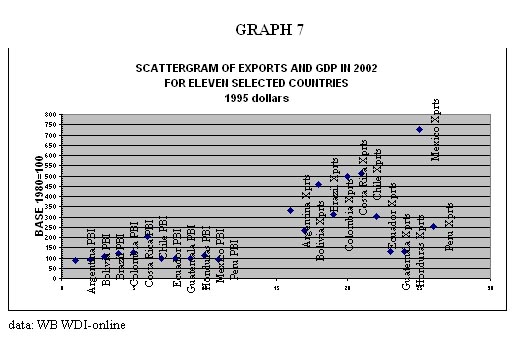
and social problems introduced, the results are meager. Exports have grown
substantially but bear little relationship with GDP per capita when we
take 1980 as the base year. (see graph 6)
 |
Conditionality
seems to have supported export growth and inflation control but not income
growth, or even less, wage recovery or employment. There is not much to
be said about exports and growth. In terms of IMF mandate, this means
that they have facilitated the expansion of world trade but have failed
at maintaining high levels of employment and real income, have proved
incapable of keeping exchange stability in Mexico (1994), (the devaluation
went from 3 to the dollar to 10 to the dollar), Thailand (1997), Brasil
went from 1 real tom 3 reales to the dollar (1998) and Argentina, from
1 to 4 to the dollar (2001) are to witness, nor have they been able to
lessen the degree of disequilibrium in the international balance of payments
of member, as is witnessed by the US deficit and the major Chinese surplus.
The
result after twenty five years is that the balance of payments of Latin
America on the whole is financed by emigrants who cannot find proper employment
in their home country and growth is very unstable. Amongst the sources
of foreign exchange in the economy, after the net revenue of goods and
services comes the revenue from exports of people, just below foreign
direct investment, but over portfolio investment, tourism, and loans.
 |
Co responsibility and the IMF
Creditor
debtor co responsibility was raised since the beginnings of the so called
“debt crisis”. The first time the point came up was at an Organization
of American States conference on external debt, meeting in Caracas, September
7, 1983 which concluded with a declaration under the name Bases para un
entendimiento where shared responsibility was brought forward in view
of high US interest rates, inflexible IMF conditions and a short leash
policy of debt renegotiation. At the Latin American Conference of Heads
of State held in Quito, January 9 to 13, 1984 the concept of co responsibility
was recognized as a major issue at the political level and where they
demanded that IFIs, international private banks and leading Governments
take their share of their co responsibility at the same time as Latin
American and Caribbean countries made their best efforts to keep their
payments to date. James Baker, U.S. Secretary of the Treasury made at
the IMF 1985 Seoul spring meeting a debt management proposal which was
a recognition of co responsibility. The Catholic Church made its first
report on debt and called for co responsibility through Un Informe
Etico de la Deuda Internacional made by the Pontifical Commission
in Rome in 1986 which then led to the Jubilee movement in 2000. The G7
made the same recognition in 1988 when it discussed the Toronto terms
of debt management. The meaning of co responsibility does not seem to
be clear. Eurodad demands that IFIs “need to publicly acknowledge the
roles they played in exacerbating indebtedness in poor countries”. This
is true not only for the poor countries but for all developing nations.
Co responsibility then as now was a ´political declaration that bore little
effect in terms of policies and “paying the price”. The debtors paid the
price mostly. The IMF did not claim any responsibility of the creditors
in the loan terms and interest rates as the case should have been given
its multilateral essence.
The
1980’s saw how Governments exported more than half of national savings
at the cost of adjustment policies which reduced Government wages, education
and health expenditures, thus disorganizing Government bureaucracies and
overall creating conditions leading to a loss of governance. Boughton,
the Fund’s historian refers to this as
The 1980s brought more economic success than the 1970s, especially
through the stabilization of prices. Although global output growth continued
the declining trend that began in the 1970s, a gradual improvement in
policymaking laid the groundwork for the noninflationary growth that many
countries would enjoy in the 1990s. Major parts of the world economy,
however, suffered some of the most severe economic stresses of the century.(21)
By the end of the 1980’s it was clear that inflation could be put under
control but that the impact of reforms on economic growth was adverse
to begin with. The hope was that this would open up the conditions for
future growth on a new basis. The sole example was and is Chile. The private
financial sector could not finance the world alone, and some conditions
were required in order for loans to be recovered. It was not clear then,
nor now, if those conditions are the ones set by the IMF, as was seen
with the Mexican crisis of 1994, the Asian crisis of 1997, the Russian
crisis of 1998, the Brazilian crisis of 1998, and the Argentine crisis
of 2001., to name but a few.
.
The argentine crisis and the IMF credibility gap
The
first problems of credibility began in Thailand and Stiglitz has written
about them extensively. The Stiglitz/Summers debate was a centrepiece
that aired how the IMF lost its reputation and how the US Treasury, in
spite of ignoring the IMF for itself, uses it for foreign policy purposes.
Summers made sure Stiglitz left the Word Bank, where he held the post
of Executive Vice President, and then “One of Stiglitz’s proteges, Ravi
Kanbur, had been put in charge of writing the Bank’s World Development
Report 2000 focusing on world poverty. The Report was to be released
in September but by June Kanbur felt in all conscience he couldn’t continue.
When the report finally appeared, Kanbur’s sections on the necessity of
social spending, redistributive tax policies and control of speculative
capital were either gone entirely or had been significantly watered down.
With the help of pressure from the US Treasury the politics within the
Bank remained firmly in favour of the Washington Consensus.” (New Internationalist
336,July 2001) Kanbur was also sacked.
The
essence of the discussion was the speed with which capital accounts were
opened and the usefulness for Wall St of Summers recommendations from
the Treasury versus a more discrete approach to capital movements. In
the end the Asian crisis, says Stiglitz, is a by product of market fundamentalism,
aggravated by IMF recommendations in the same direction.
Unfortunately
for the Fund, the following year after this debate (2000), the Argentina
crisis exploded. In brief, Argentina decided to follow a convertibility
plan in 1990 in order to brake inflation and stabilize the economy. This
fixed rate was at 1 peso 1 dollar par and worked fairly well between 1990
and 1997 but in 1998, when Brazil devalued its currency also from par
1 to 1, to 3 reales to 1 dollar, the strains appeared in Argentina’s a
accounts. Brazil was a main trading partner of Argentina at the time since
the signature of Mercosur, an integration scheme that includes Uruguay
and Paraguay. The impact of the Brazilian devaluation on the Argentine
economy was quick and strong, resource transfers started to be negative
as depositors took their money out and new foreign investments did not
materialize. The level of foreign debt had doubled during the 1990’s and
the national budget was strained to keep its debt payments to date. In
face of this, the decision made in Buenos Aires with IMF support was to
keep the exchange rate fixed at 1, and tighten monetary supply as much
as possible in order to prevent a devaluation. The result by 2001 was
that liquidity shortages forced barter, that alternative monies were introduced
in the different States of the Nation and that foreign debt increased
substantially in order to finance the rate of exchange. The private sector
could only borrow abroad so overall total indebtedness grew substantially
in the last two years before the crisis. By December 2001 this was no
longer manageable and the IMF decided to suspend its standby programme.
One week later they declared a default. Institutionally the IMF did not
learn the Mexican lesson from 1994: that floating rates are better than
fixed rates when there is a sudden serious imbalance as a result of an
external factor.
In
the aftermath, the research director of the IMF wrote a book titled Argentina
and the Fund : from triumph to tragedy (Mussa, 2002) where he describes
the problem and washes the IMF’s hands from what occurred. As Argentine
GDP was contracting in 2002, the IMF was making a public relations campaign
on how it was not responsible for what its advisees do. How they are only
external advisors and how it was a real shame that Argentina had lost
its opportunity. It did not rescue Argentina nor did it assume any responsibility
with the creditors as to what happened. Even less so with the people or
Argentina.
By
2004 Isabelle Mateos y Lago from the IMF wrote an independent evaluation
report paper where she did an outside evaluation and said:
The role played by the International Monetary Fund (IMF) deserves special
attention for at least three reasons. First, unlike the cases of Indonesia
and Korea, where the IMF had no program involvement for several years
preceding the crisis, in Argentina the IMF had been almost continuously
engaged through programs since 1991 (Box 1.1). Second, again unlike the
other cases, the crisis in Argentina did not explode suddenly. Signs of
possible problems were evident at least by 1999, which led the government
to seek a new Stand-By Arrangement (SBA) with the IMF in early 2000. Third,
IMF resources were provided in support of Argentina’s fixed exchange rate
regime, which had long been stated by the IMF as both essential to price
stability and fundamentally viable. Drawing lessons for the future, in
evaluating the past, and especially in determining accountability, it
must be kept in mind that much of what we know now may not have been known
to those who had to make the relevant decisions. (2004 a)
In the press conference where the report was presented, this was added
:
In terms of the assessment of the fundamental causes of the
crisis, it is our judgment that it was essentially a combination of the
failure of Argentinean policymakers throughout the 1990s-and during the
crisis period of 2000-2001-to take the necessary corrective action to
make sure that domestic policies were compatible with the choice of the
exchange rate regime. (2004b)
…
But the message is very clear from the Argentina case, too, that many
programs that are not dealing with the most fundamental structural problems
underlying vulnerability--and in this case it's fiscal structural problems--are
in the end not very productive. And so, you know, the Fund should perhaps
not have had so many programs with Argentina during the 1990s.
…
So our main message about the weaknesses of the Fund's role during this
period was essentially not with the initial decision in January 2001.
As I said, judged in a probabilistic sense, it could be justified. But
it was with the lack of sufficient contingency planning, and because of
that the decision to continue supporting a strategy that under most reasonable
judgments one could have concluded, even with information at the time,
was not working.
…
On the August package, we're absolutely clear in the report that we think
it was a mistake. And, in fact, we're also saying that the May disbursement,
you know, the Third Review under the program, was also a mistake in our
view because the situation was unsustainable, clearly unsustainable.
…
We're suggesting that these $9 billion essentially that were disbursed
between the spring and September could have possibly or hopefully been
put to more productive use if they had been used in support of, say, a
move to Plan B, a devaluation, or something like that, could have been
used to limit the overshooting of the currency depreciation, and in the
meantime would have avoided further deterioration in banks' balance sheets,
would have avoided another six months of a really sharp recession.
The IMF was not responsible in the last instance, says Mateo, because:
The IMF is only one of the actors involved. In practice, the country
itself is ultimately responsible for its policy decisions. This is especially
important when the underlying policy choices are strongly owned by the
country? as they were in Argentina.(8:2004a)
This
disclaimer weakend the credibility of the Fund more that it helped understand
the Argentine crisis. If the IMF was supporting a fixed exchange rate regime,
and financing it, it is not a mistake of argentine policy makers, but an
agreed a policy with the IMF. If there was no contingency plan if stability
was not maintained, then it was incompetence on both sides. Added to Mussa’s
book, the Mateo work finished burying the institution. In the mean time
the new Argentine president took it upon himself first to get the proper
economic advise in order to have economic recovery. The result can be seen
in the table below. Secondly, he negotiated the foreign debt, bloated in
the last IMF supported mega swap of 2001, and reduced the stock of the debt
by 75%, without IMF advise. More than 80% of the creditors accepted these
terms. Then he decided to pay the IMF back its loans so they would no longer
require their services.
The IMF moved in to the centre of a credibility gap. It showed the world
it was not a guarantor of sound economic policies as it was meant to be,
but equally it was not a loan guarantor nor was it a lender of last resort.
What is it then? The Asian Monetary Fund, The Asian monetary
unit and the future of the IMF
At the time of the Asian crisis, the Japanese Government launched the
idea of having an Asian Monetary Fund that would take care of Asia’s balance
of payments problems. When the Japanese Government announced its intention
to do so, the US Treasury expressed its opposition to the idea and reinforce
the role of the IMF. Bergsten (1998) suggests that it generated fears
that it could undermine the leadership role of the IMF and foster a split
between Asia and the United States. An Asian dominated fund would reduce
its influence in the region and would have shattering effects on the IMF
and the World Bank.(Lipscy, 2003).
Nevertheless, in Chiang Mai, Thailand, in May 2005, the ASEAN country
members led by Japan, China, South Korea and including the ten country
members, agreed to expand their bilateral swaps and form a certain protected
currency area. This initiative covers sixteen countries and has a 40 bn
dollars fund.. (http://www.aseansec.org/afp/115.htm)
On
the other hand, in Latin America, Venezuela has acted as a lender of last
resort, purchasing central bank positions without conditions, thus allowing
the Argentine Government, to name one, the policy space to do what it
feels is correct in terms of inflation control and economic growth. Others
that have benefited from Venezuelan largesse are Bolivia, Ecuador and
Colombia. President Chavez has said he wants to have a Latin American
IMF.
Additionally,
from 2002 onwards Argentina first and Nigeria later, negotiated their
debt without the IMF, and both private and public creditors allowed them
to do so. At that point the credibility gap was so large it was pointless
to call in the IMF as a guarantor of either sound economic policies or
lender of last resort. The major debtors returned the Fund the money borrowed
from them ahead of schedule in a way of getting rid of conditionality,
thus earning degrees of freedom at a time of international uncertainty
on the future of the US dollar. In 1998, twenty one countries had standby
loans. In 2006, there are only four and Indonesia has announced it will
also pay the Fund ahead of schedule. The stock outstanding of debt owed
to the Fund was 138 billion US$ in 1998 and has been reduced to 35 bn
dollars in 2006. Bankers gathered around the Institute of International
Finance addressed the IMF chair stating that they had doubts on the effectiveness
of their recommendations”.(IIF, 2006) In brief, neither debtor Governments,
leading G7 governments nor bankers believe in the IMF any more.
In this context the Executive Director of the IMF has pursued a policy
of revival seeking a new role, much like in the past. Nevertheless it
is generally recognised that the representation system is not adequate
for the new world, that there is little transparency on elections, that
policies are not adequate and that they no longer serve as international
guardians.(Truman, 2005) Nothing will help get it back to where it was.
The IMF and the United States
The
issue of the US deficits and what to do about them is key to recovering
its credibility. It is evident that the US Treasury ignores the IMF recommendations
and that it prefers to blame the rest of the world for its ills than assume
responsibility for its misdoings.
Undersecretary
Adams of the US Treasury made a statement April, 19, 2006, where he describes
the US economic position:
We will also seek to advance fundamental reform of IMF governance.
Modernization at the IMF needs to reflect rapid growth in many emerging
markets and other key changes, such as the euro's advent. The IMF is
a shareholder institution; members' roles should reflect their relative
global economic weight. There is growing consensus on a two-step process.
The first step would involve a small ad hoc increase for the most underweight
emerging market countries around the time of the Singapore Annual Meetings.
But this must be credibly linked to near-term completion of broad second
step reforms. Such reforms should include revamping of IMF's quota formulas
to make GDP the key variable, or developing an alternative metric to
this end; achieving a further increase in emerging market countries'
weights; and examining concrete actions to rationalize Executive Board
representation. Fundamental reform also needs to bear in mind the voice
of poor countries. We are confident that all countries ? with a collective
interest in an IMF that is strong, legitimate, and relevant ? will help
to provide leadership and find a consensus. (Statement by Under Secretary
for International Affairs Timothy D. Adams in Advance of Meetings of
the G-7, IMF, and World Bank)
The IMF article IV consultation to the United States produced at the
same time says the following: http://www.imf.org/external/np/ms/2006/053106.htm
Reducing External Imbalances
7. The ease with which the United States has financed its
record current account deficit has been remarkable, but is unlikely to
be sustained indefinitely. A number of (possibly temporary)
factors, such as short-term interest rate differentials and increasing
demand for long-term bonds, have helped support the U.S. current account
deficit and dollar over the past year. However, most forecasters project
that the current account deficit will rise further in coming years, which
may begin to strain the global appetite for U.S. assets. Delaying the
inevitable multilateral adjustment will mean continued increases in U.S.
external indebtedness, magnifying the potential for disruption to exchange
rates, financial markets, and growth, both domestically and abroad.
8. Firm and vigorous implementation of the cooperative strategy
laid out by the IMFC last April would support an orderly resolution to
global imbalances, and the Fund will use its new remit for multilateral
consultations toward this goal. The United States has a
major role to play in addressing this shared responsibility, and its main
task remains to boost national saving, including by more ambitious fiscal
consolidation.
9. Leadership by the United States remains key to global trade
liberalization. With progress slowing in the Doha Round
negotiations, continuing U.S. commitment and initiative are essential
to generate new momentum for a timely and ambitious conclusion. It also
remains imperative to resist protectionist responses to global imbalances,
particularly as restrictions on trade risk creating significant harm to
the global economy. As we have long cautioned, the growing number of bilateral
trade initiatives by the United States and others could undermine the
multilateral trade system, and there would be merit in seeking agreement
on common disciplines.
Putting Fiscal Policy on a Sustainable Path
10. As highlighted in the Budget, demographic and other pressures
threaten both fiscal sustainability and the nation's future prosperity.
Spending on Social Security, Medicare, and Medicaid currently account
for over two-fifths of federal spending and is rising at an unsustainable
rate. While there is no doubt that entitlement reform is essential for
achieving a sustainable fiscal position, recent CBO analysis illustrates
that even significant entitlement reforms and cuts in other spending may
not be sufficient to accommodate the increased demands from an aging population,
particularly on public health systems.
11. With the Administration indicating that it will achieve
its objective of halving the deficit earlier than anticipated, the time
is opportune to establish a more ambitious medium-term fiscal anchor.
There will soon be the need to define a new objective consistent with
the Administration's longstanding commitment to deficit reduction. With
revenues continuing to be buoyant, we would again propose a target of
balancing the budget excluding the Social Security surplus over the next
five years. Such an objective would place the U.S. federal debt-to-GDP
ratio on a clear downward path and reduce the burden on future generations,
while providing the room needed to develop and phase in reforms of health
and retirement systems. This would require consolidation at a rate of
around ? percentage point of GDP a year, which would ease the burden on
the Fed for keeping economy close to capacity while raising national saving
and reducing global imbalances.
12. We agree that expenditure discipline should remain central
to deficit reduction, but revenue measures cannot be ruled out.
To be sure, there has been some success in slowing the growth of outlays,
but the Budget projects that the federal deficit will remain around 2?
percent in FY 2007, roughly unchanged in three years despite the strong
economic expansion. This suggests some risk that the deficit reduction
that is projected in subsequent years may be difficult to attain, especially
since it does not take account of ongoing operations in Iraq and other
fiscal pressures on revenues and outlays. Thus, action on both sides of
the ledger may be required:
- On the expenditure side, entitlements and defense commitments limit
the room for cuts, and the Budget already assumes that the ratio of
discretionary spending to GDP will be reduced to unprecedented lows
over the next five years. Indeed, recent Congressional debate over emergency
appropriations underscores how difficult it will be to contain discretionary
spending. Although budget rules cannot substitute for an underlying
commitment to fiscal discipline, this suggests that there would be merit
in re-introducing caps on discretionary outlays and pay-as-you-go (PAYGO)
requirements, which had been successful during the fiscal consolidation
in the 1990s. However, it would also seem prudent to extend the PAYGO
rules to include the impact of tax measures, as was the case under the
1990 Budget Enforcement Act.
- On the revenue side, the significant reductions in marginal tax
rates in recent years have supported economic efficiency. Although
it may be difficult to sustain these tax cuts while meeting the fiscal
burden from population aging, the priority should be on reforms to broaden
the revenue base. The President's Advisory Panel offered useful suggestions
along these lines, but consideration could also be given to consumption-based
indirect taxes?such as a national sales tax, a VAT, or energy taxation?that
would maintain revenue buoyancy as workers retire.
This gentle appreciation for what is a 6% of GDP deficit in a country that
reduces tax revenues by introducing tax cuts at a time when its fiscal deficit
is growing, does not follow suit in tone or in essence to the treatment
given member countries. Stiglitz said in the Wall St Journal of June 21,
2006 that the credibility of the Fund lies in what it is able to do with
the US. From the article IV report, it appears that not much. The IMF remains
a U.S. foreign policy tool ignored domestically by the US Government. The
Fund does not have the clout to make it enter into its net..
IMF
reform or international financial architecture reform?
After
the Mexican, Asian, Russian, Brazilian and Argentine crisis, is the Fund
required? Can it be reformed? Can it recover its credibility? There are
two ways of looking at this. Reform for what, should be the question. If
the element that launched the idea of reform is the fact that they can no
longer pay their way with such few loans and interest revenues, the issue
is domestic to the IMF. If the question is how to recover international
credibility, the issue is how to recover a multilateral actor. Credibility
has been lost by not having a transparent voting mechanism to elect the
Executive Directors and by keeping the 1946 gentleman’s agreement that the
World Bank chair went to the United States while the IMF went to the Europeans.
This is nowhere written but has been the de facto manner in which IFIs have
worked. It was designed as a rich man’s club in 1944 when the US was the
almost sole creditors in the world and the rest borrowed from it. As a result,
its veto power made sense. It was their money mostly. However by 2006, the
US is a leading world debtor, it does not have money but major debts, mostly
to Asia but also to Latin America and to any surplus economy that holds
reserves in US dollars instruments: namely Treasury Bills. Nevertheless
it holds its veto power which it uses as a foreign policy tool to prevent
loans to its declared “enemy” countries such as Nicaragua in the 1980’s
or Cuba, to name but two. This is an exercise of power with no real financial
substance given the US is now the world’s major debtor and that it owes
its money to Asian and Latin American countries, all with the exception
of Japan, lesser developed than itself. The IMF keeps from yesteryear the
size of GDP to measure the voting rights and the US is still a very large
economy, but the size of GDP does not reflect the financial capability of
the country anymore. Credibility has also been lost because they have not
been able to stand the pressures from crisis generated by their own model
of capital account opening in Asia or by their own advise on how to handle
exchange rates in various parts of the world.(see the more recent independent
evaluation on this matter, IMF 2006)
Paradoxically,
the US Under Secretary of the Treasury has said the IMF should do its original
mandate: “international financial stability and balance of payments adjustment”.
The problem says Truman (2005) from the IIE, is that the IMF can become
a development institution working solely with low income countries and lose
its relevance. For the IMF to recover its credibility and do what the US
undersecretary suggest it needs to do again, the institution would need
to have the clout to bog down the US deficits in the same way as they have
done with everybody else, including Britain in 1977-78..The Fund has become
weak and ineffective. Can it bail out the US in the event of a run against
the dollar? No. In fact, it cannot bail out any major emerging market in
the event of an exchange run, as was seen in Argentina, 2001, Asia in 1997
an Mexico,1995. All of these were stopped with the direct intervention of
National Treasuries that financed a substantial part of the rescue.. Truman
(14) suggests the Fund should reaffirm its central role in international
crisis, including large scale lending activities. He makes the point that
in the 1970’s no one spoke of the moral hazard element and that given financial
globalization there is more need today for a lender of last resort than
ever. This is a reflection on the path economic theory took between the
1960’s and today. Is the issue of moral hazard relevant in international
bank lending and financial rescues? Or is it confusing the issues of a closed
economy and private borrowing with those of public borrowing and an open
economy? Says Truman that capital accounts and the financial sector are
central to the IMF’s role in the XXIst century.
Seen
with more distance and less sympathy, Bello and de los Reyes (2005) suggests
reducing the IMF rather than either reforming it on its past basis or getting
rid of it. Without the resources it had in 1945 in terms of GDP, or more,
of the member countries it does not have the means to face future crisis.
Bello and de los Reyes suggests that the IMF’s Stalingrad was in Asia. “The
IMF was widely discredited, being seen as the architect of capital account
liberalization that created the crisis, and of the severe contraction that
followed.”(2005:1) Perhaps on top of its Stalingrad it had a Waterloo, so
Argentina really added insult to injury. Bello and de los Reyes stress that
“In Malaysia, Prime Minister Mohamad Mahathir defied the IMF by imposing
capital controls, a move that raised a howl from speculative investors but
one that ultimately won the grudging admission of the IMF itself as having
stabilized an economy in serious crisis. Many eminent establishment critics
agreed that the Fund “should have tried unorthodox combinations such as
fiscal expansion, monetary contraction, and capital controls.” (2005:1-2)
The
result of the crisis, is that with 45% voting power concentrated in the
G7 countries, and 17% in the US, when only 15% of the votes are required
for a veto, the institution does not reflect the new world economic actors.
Thus, they say, the IMF reflects more the interest of the G7 countries
than those of the rest of the World. This one way in which it is an arm
of US foreign policy. Bello and de los Reyes suggest that “For political
reasons, it may prove difficult to abolish the IMF. But it can be disempowered
and converted into a research agency tasked with monitoring capital flows.”(6).
They also suggest that “In the global financial architecture, regional
arrangements such as a regional financial institution can supplant the
IMF as a regulator of global finance.” (7) because crisis are regional
in nature and they can be stopped within a region.
Bello
and de los Reyes conclude by saying that “More space, more flexibility,
and more compromise--these should be the goals of the Southern agenda.
Robin Broad,(2005) looks into the World Bank and finds it equally inadequate
with more professionals doing academic work than reflecting on development
issues as they come up. She suggests that the World Bank failures can
be met with a sharp reduction in personnel and making them accountable.
The point is to shrink the institution rather than getting rid of it.
On the other hand, the Joint Economics Committee in the US congress ,
led by representative Saxton said “"The World Bank must be made more
effective and focused on achieving real results in reducing poverty and
misery in developing countries. The performance of World Bank projects
must be closely scrutinized to ensure that resources that should be used
to benefit the poor are not wasted. Further progress toward grant financing
of World Bank projects is needed. In addition, the World Bank could provide
technical advice, and foster needed institutional reforms," (JEC,
2006) Saxton concluded. The lack of results point in Braod’s direction
rather than inm Saxton’s. It does not function.
Mainstream
academics and opinion makers conform a crowd of abolitionists together
with critics from the other shore who want to get rid of the IMF and the
WB altogether. These include Akyuz, (2005) Walters (1994); Schultz, Simon
and Wriston (1998); Schwartz (1998) and Milton Friedman (2004) who argue
for closing down both the World Bank and the IMF on grounds that they
have done more harm than good, and have the capacity for continuing to
do more harm than good. Lissakers suggests that it needs to have bigger
facilities without conditionality in order to prevent major crises. If
it is true that it does more harm than good, this refers to the conditions
attached to the use of lifesavers and not to the fact that there is a
lifesaver. A bigger IMF without conditions for the first or second tranche
could have been an alternative but the possibility that with their capacity
to impose conditions they will do so again is high, and their nature of
doing so is itself a reason to think of having decentralized stabilization
funds. The regionalisation of monetary stabilization funds is a good idea
so long as conditions are not attached that muddle up its workings
In conclusion: towards a new international financial architecture
The
conclusion from the arguments of the role of the IMF and the Development
banks is that in the first place, the results of what has been done over
two and a half decades is not promising. If it is true that inflation
is under control and that budgets are better managed, on the other hand
the lack of results in terms of employments, wages and GDP per capita
point in the direction that the policies are flawed. It is evident that
exports grew but it also is evident that migration is the main source
of revenues and growing more quickly than the balance in current account
of the balance of payments. There is not much evidence of a relationship
between exports and growth in Latin America over twenty five years with
the exception of Chile. The speed of export growth does not imply a fast
economic recovery,.
Finally,
if Structural Adjustment Loan policies have resulted in this combination
of outcomes, the question is what is the role of a development bank? Should
the World Bank be placing conditions on loans in order to obtain structural
changes so that these results can be shown? Given it deals with development,
should it not worry about employment, wages, income distribution, and
basic health and education indicators as well as environmental degradation
and gender balance?
The
impression it gives overlooking two and a half decades of bad country
performance in Latin America is that they worry about the rich getting
on and that the poor should pay the brunt of the effort. Increased indirect
taxation as well as tax reductions for new investments have been at the
center of policy recommendations that have not produced growth, but have
generated more income inequality, Labour flexibility, meant to generate
more employment, has landed being a source of social instability, violence
and migration, instead. Opening of capital accounts has not been reflected
in increased investment rates. Export promotion has resulted in export
led stagnation. What is the purpose of the World Bank?
The proposed new architecture:
A
new international financial architecture is required and it must include
a new set of rules and institutions:
- A universal legal code that will make sure all creditors have the
same rights and all debtors the same duties, with the same enforcement
mechanisms. This is analogous to what has occurred with international
trade law in a process led by a UN commission called United Nations
Commission on International Trade Law. (UNCITRAL) Currently international
loans are signed using domestic laws of the US and UK.
- It is clear that these problems recur, an International Board of Arbitration
for Sovereign Debt is required as a new forum for negotiations instead
of the Club of Paris and London Club. It should have a small secretariat
as a part of the UN system as an international body that will function
regularly and used by UN member countries. UNCTAD would appear to be
the likely place since they have DMFAS and experience with dealing n
foreign debt.
- The IBASD Secretariat will recommend arbiters that will be selected
by creditors and debtors in even proportions with the presidency decided
by both sides in order to have an uneven number of board members. The
inspiration of the IBASD lies in what was proposed for the German debt
agreement of 1952. (Hersel, 1998)
- Collective Action clauses must be incorporated into all new instruments
in order for the recommendations that follow to operate. These consists
of clauses whereby a majority of bondholders represent all, using the
Mexican precedent.
- No creditor/debtor discrimination must remain and the elimination
of free riders is urgent in negotiations. Debt cancellation for the
poorest countries in this approach should be immediate and unconditional
given they have no payback capacity and that conditions placed on them
have further damaged their capacity to have economic development, even
less to work their way towards the MDG. The HIPC initiative n its three
phases has proven a failure. Negative resource transfers from countries
with income levels of under 1,000 dollars per capita with a PPP of about
the same or less, a substantial percentage of the population with AIDS,
and with massive undernourishment does not seem to speak of serious
bargaining but on the exertion of power by multilateral banks.
- If there was any evidence that HIPC conditions lead to better income
levels, they might be considered, but there is nothing of the sort.
HIPC conditions seem to confuse the issue that if Governments spend
more on social sectors, they are advancing, much the same as is that
more exports per se lead to more GDP growth, which they do not.. HIPC
would have been taken seriously into account if income per capita in
terms of constant PPP was improving or had done so. Nicaragua. Honduras
and Bolivia are cases in point. It is not only too little too late,
but inadequate.
- It is correct that up to 100% of multilateral debt can be cancelled,
but the concept should be to keep all creditor categories under the
same treatment until the negative net resource transfer becomes cero
or positive, and the conditionality should be related to economic, social
and cultural rights. The MDGs is one step in that direction.
- Regional stabilization funds should act as buffers against speculation
in the money markets and should also watch the trends of the capital
accounts of its member countries in order to suggest preemptive adjustments
if the case may be, lending ahead of time.
- The concept that the statistical office of the World Bank remain in
operations while the rest of the bank disappear is attractive as the
data gathering experience is high, and the capacity to distribute the
data and disseminate the data banks is broad.
- In the future, the new institutions should be kept from the influence
of foreign policy in such a way that they may work effectively with
all member countries and not be subject to the whims of any major partner.
BIBLIOGRAPHY
Akyuz, Yilmaz
“Reforming The IMF: Back To The Drawing Board”, Third World
Network. Geneva, November, 2005
Bello, Walden & Julie de los Reyes
“Can the IMF be reformed?”, International Regulations, Paris-Tokyo,
August, 2005, http://www.socioeco.org/forums/d_read/intreg/IMF_delosreyes_bello.pdf
Bergsten, C. Fred
“Reviving the Asian monetary Fund”, Policy bried 98-8, Institute
of International Economics, December, 1998.
Bresser-Pereira, Luiz Carlos
“A Turning Point in the Debt Crisis: Brazil, the US Treasury,
and the World Bank” en Revista de Economia Politica, 19(2) abril
1999: 103-120. Originalmente publicado em Sao Paulo: Fundacao Getulio
Vargas, Departamento de Economia, Texto para Discussao n° .48, novembro
1995.
Broad, Robin
“The World Bank” at Intreg, Tokyo-Paris, 2005,
http://www.socioeco.org/forums/d_read/intreg/
Borchard, Edwin.
State Insolvency and Foreign Bondholders. Vol. I. General
Principles. Yale University Press, New haven, 1951.
Boughton, James
-------- “Why White, Not Keynes? Inventing the Post war International
Monetary System” IMF Working Paper, WP/02/52,
--------Silent Revolution: The International Monetary Fund, 1979-89.
IMF Oxford University Press Washington D.C. 2001
--------“The Case Against Harry Dexter White: Still Not Proven”
IMF Working Paper No. 00/149, August 1, 2000
--------“The IMF and the Force of History: Ten Events and Ten Ideas that
Have Shaped the Institution”, IMF Working Paper No. 04/75, May 1, 2004
Corporation of Foreign Bondholders
First Report of the Council, London, 17th February 1874.
Thirty-first Annual Report of the Council, London, February 1904
Fifty-seventh Annual Report of the Council, London, 1930
Eighty second annual Report of the Council, London, 1955
Friedman, Milton.
“60 at 60: Is There a Need to Change the Structure of the IMF and World
Bank?” Emerging Markets 60th Anniversary Special,.2004
IMF
“The IMF's Advice on Exchange Rate Policy” - Issues Paper for
an Evaluation by the Independent Evaluation Office (IEO), June 23, 2006
Lipscy, Philip
“Japan’s Asian monetary Fund Proposal”, Stanford Journal of
East Asian Affairs, Vol. 3, No. 1, Spring, 2003 pp. 93-104
Mateo, Isabelle
“Report on the Evaluation of the Role of the IMF in Argentina”,
1991?2001, IEO, IMF, (2004a) in http://www.imf.org/External/NP/ieo/2004/arg/eng/index.htm
Transcript of IEO press briefing on Evaluation
Report on the Role of the IMF in Argentina, 1991-2001 , IMF Independent
Evaluation Office, Thursday, July 29, 2004 Washington, D.C. (2004b)
in http://www.imf.org/External/NP/ieo/2004/tr/eng/tr072904.htm
Mussa, Michael,
Argentina and the Fund : from triumph to tragedy .
Institute of International Economics, Washington D.C. 2002
Schultz, George P, William E. Simon, and Walter B. Wriston.
“Who Needs the IMF?” Wall Street Journal, 3 February,
1998
Schwartz, Anna J.
“Time to Terminate the ESF and the IMF.” Cato Foreign Policy
Briefing, 1998
Stiglitz, Joseph
“ What I Learned at the World Economic Crisis. The Insider
“ The New Republic 17apr, 2000
Ugarteche, Oscar.
-----El Estado Deudor - Economia politica de la deuda:
Peru y Bolivia 1968-1984, Instituto de Estudios Peruanos, Lima, 1986
Walters, Alan. (1994). Do We Need the IMF and the World Bank? London:
Institute of Economic Affairs.
Williamson, John
-----(2003) “The Washington Consensus and Beyond”. An article commissioned
by the Economic and Political Weekly.
-----(2004) “The Washington Consensus as Policy Prescription for Development”
lecture at the World Bank,
http://www.iie.com/publications/papers/williamson0204.pdf
Viner, Jacob
“Dos Planes para la Estabilizacion Monetaria Internacional”
El Trimestre Economico, Vol. X, no. 3, Mexico DF, 1943, pp.450-482
|